
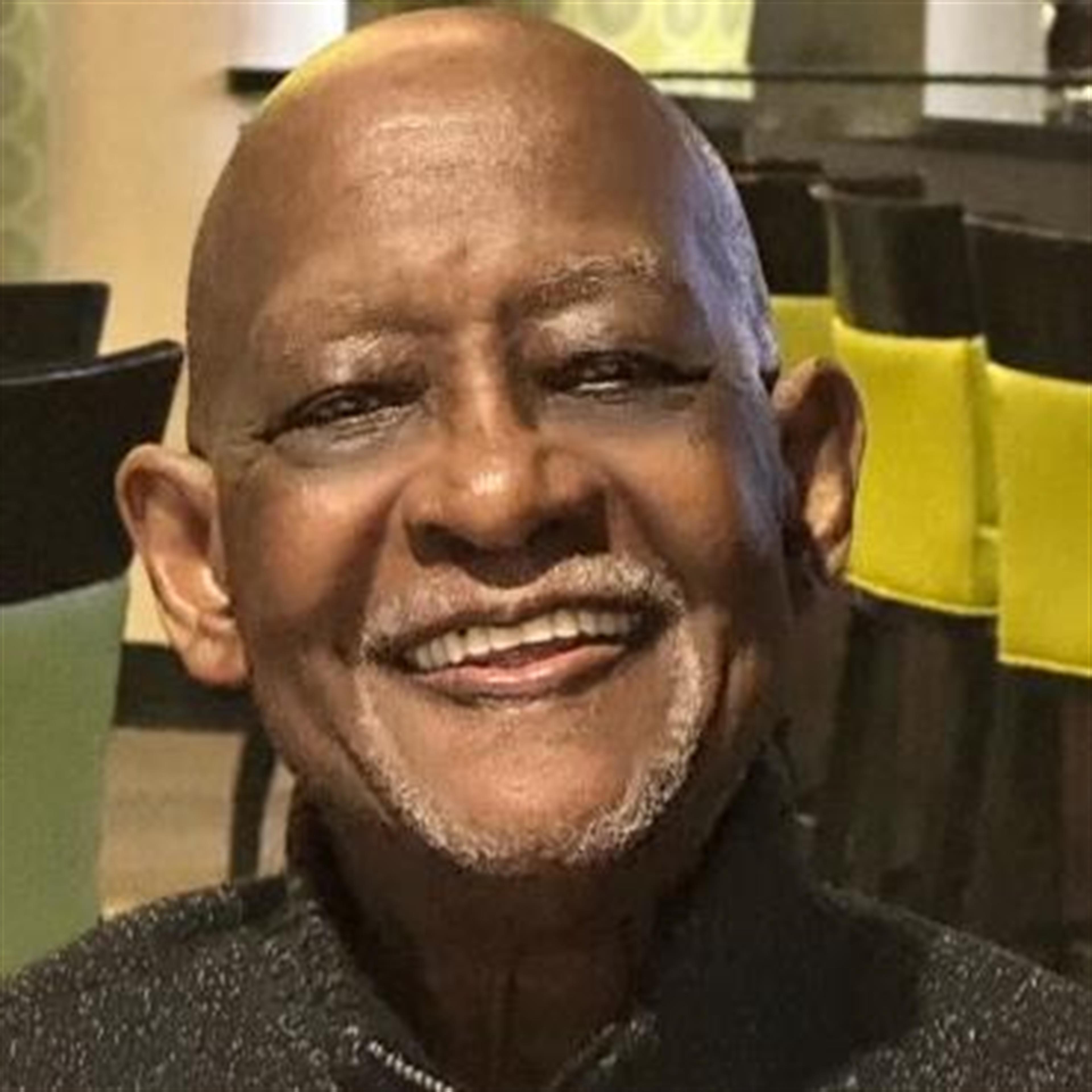
Mr. Lionel Oscar Barton's Obituary
Lionel Oscar Barton, who parlayed his mathematical skills into a successful career as a Geophysicist at Chevron, USA, and into an exciting hobby as a world-class player of contract bridge, passed into eternity on April 16, 2024, at a hospital in Houston, Texas, after a valiant fight against the ravages of kidney disease.
Oscar, as he was known to family and many friends, was born in the village of Buxton, Guyana, to the late Inez Barton (née Taylor) and Lyndon O’Dowd Barton. Owing to the early death of his mother, the nurturance of Oscar, his older sister, Olive, and his younger brother, Winston, was provided by their stepmother, Mary (“Sister Mary”) Barton (née Cromwell). Oscar also credited his older brother, Lyndon Barton, with guiding him, especially during his teenage years.
Oscar took the crucial Scholarship (or 11+) exam at Arundel Congregational School in Buxton, and his scores merited a P.P.P. Government Exhibition that enabled him to enter the prestigious Queen’s College in 1953. His power and competitive spirit were quickly evident in the classroom and on the playing fields. In the former, his specialty was Mathematics and Physics and, by the time he reached Upper 6th Modern (b) in his last year at Q.C., he was the top student in his form. In the latter, his modest triumphs on our cricket field in Thomas Lands were likely overshadowed by his play for the Buxton cricket team, to which he was recruited on occasion by its captain, who happened to be his older brother. In a recent conversation, Lyndon insisted that, while he really needed Oscar’s prowess on the team, he was careful to offer a quiet space in between innings for him to do his homework!
In 1960, Oscar took the University of the West Indies Open Scholarship examination, and a few months later he sat for his GCE “A” levels. His performance on these exams was so outstanding that the Government of Jamaica took the unprecedented step of awarding him, a Guyanese, a Jamaica Government Exhibition to study Natural Sciences at UWI in Mona, Jamaica! (Years later a theory of this event emerged, according to which there were 7 Open Scholarships to be awarded and, on merit, students from Guyana could have won 5 or 6 of them. The larger governments of Barbados, Guyana, Jamaica and Trinidad & Tobago agreed that such an outcome would not sit well politically. To solve the dilemma, they increased the number of Opens to 9, and awarded 5 of them to students from Guyana and 4 to students from Barbados. The 6th deserving Guyanese was none other than Oscar Barton and, as part of this multilateral bargain, the Government of Jamaica agreed to award him the Exhibition. Few, if any, of the principals in this event are with us today to confirm or deny this attractive theory.)
Oscar’s activities at UWI were even more diverse than they were in high school. There was the requisite amount of study (because those Open Scholarships and Exhibitions came with a few performance clauses), and there was his emergence as a skilled volleyball player. However, it was his career as a leading dancer in the University’s Dance Troupe that caused much wonder, and some bemusement, among those of us who knew him as a robust athlete hitting sixes and bowling fast-medium bouncers in Thomas Lands. It was a delight to see Oscar on stage tripping a light fantastic in disciplines ranging from traditional Jamaican folk dance to what we were told was a synthesis of traditional African ritual with modern and classical ballet. Further, according to one of his UWI contemporaries, Jacquey Gordon, when Oscar exchanged the stage for the dance floor at our campus fêtes, he dazzled the young women with his graceful cha-cha-cha! At such times, our delight became tinged with envy and many of us resolved to up our game, even if only within this sphere of recreational dance, as a way of remaining relevant.
After graduating with his B.Sc. degree from UWI in 1963, Oscar taught at Manning’s School, Savanna-la-Mar, one of the oldest high schools in Jamaica. After about 4 years at Manning’s, Oscar emigrated to the USA, where he worked for more than a quarter century in the geological research labs at Chevron. As was the case for many in those years, Oscar learned computer programming mainly through on-the-job training at Chevron. He also played first division soccer for Chevron’s soccer team in Houston.
In parallel with this professional growth, Oscar was developing a stunning reputation within the world of contract bridge. He and a range of partners, such as, Dwight Galley, Mae Clark, Harold Bickham, Gloria Chrisler and Reggie Chapman, played in tournaments and exhibitions around the USA and abroad, most sponsored by the American Bridge Association and some by its older and much larger counterpart, the American Contract Bridge League. Errol Grant, a boyhood friend who competed occasionally with Oscar in tournaments, explained that bridge scoring follows a complex set of rules reflecting the level of individual and team play, as well as the level of the competition; and “points” accumulate across a player’s lifetime. He was first-ranked in the nation for many years but due to getting older, a decrease in traveling and reducing his play to only two bridge tournaments per year - he ultimately dropped in rank. This perhaps explains the apparent precision in Tanya Rodich’s announcement of the sad news to the bridge community (on bridgewinners.com, 4/19/24): “Mr. Barton was second-ranked in the American Bridge Association at 42,384.34 Association points (just ahead of his protégé Mrs. Mae Clark and behind Reginald C Chapman). Mr. Barton was also a Life Master in the ACBL and a member of District 16's unit 174 in Houston.” As hinted by Ms. Rodich, Oscar served as teacher and mentor to many in the ABA community. Indeed, he achieved Grand Life Master status and was a past president of the ABA, which memorialized him in the “Lionel Barton KO Competition” at the Juneteenth Sectional Tournament in New Orleans, June 25-28, 2019. Interestingly, while Oscar’s achievements in bridge derived from the technical skills he developed as a student and professional, it is this extra-curricular success of “Lionel Barton”, not his scientific work, that is amply documented and celebrated in the digital archives of, e.g., the New York Times (which ran a bridge column until 2015), Bridge World, and bridgewinners.com.
Upon his retiring from Chevron, Oscar and his wife, Olive Barton (née McPherson), entered perhaps the most challenging and rewarding phase of their lives. In 1997, they began the construction of Lovett Place, an assisted living/senior care home in Houston, and they operated the facility continuously since welcoming its first resident in 1998.
Oscar leaves behind his loving wife of almost 40 years, Olive; their two children, Lana Barton and Omar (Shaisley) Barton, and two grandsons; his siblings, Lyndon (Olive) Barton, Olive Best (née Barton), Constance Benjamin (née Barton), Glenfield Barton and Fitzherbert Fraser Barton; and his many cousins and friends. He was predeceased by siblings, Winston Barton, Joan Otto (née Barton), Richard Barton and Lloyd Oswald Barton. Oscar was a vibrant presence in the lives of many and he will be sorely missed.
Written by Ewart Thomas (Q.C., 1953-1960)
Stanford, California
What’s your fondest memory of Lionel?
What’s a lesson you learned from Lionel?
Share a story where Lionel's kindness touched your heart.
Describe a day with Lionel you’ll never forget.
How did Lionel make you smile?
